Learning Machines, Learning Myself
What studying AI taught me about structure, meaning, and learning itself

I did not expect 2025 to unfold the way it did.
By the time summer arrived, everything I had been building started to fall apart quietly. I lost my job, more by choice than by force. The work that had once been a source of pride and meaning, over time became a source of anxiety. When it finally stopped, I felt both relief and emptiness.
I found myself in a city I did not want to be in, waiting for paperwork that seemed to have no clear timeline.
My view of life has always been that being human follows something like an inverted curve. Life rises, dips, and rises again. At every inflection point, my instinct has been to act. I usually turn to things with clear, measurable outcomes. Apply for two hundred jobs. Track progress. Build a routine. The logic is simple. Progress can be counted even when meaning cannot. An interview would keep me busy and give me something else to think about. But this time, that mechanism failed. The weight of what was happening in my life was too heavy to solve through effort alone.
When everything else felt uncertain, learning offered a way to rebuild structure and focus.
In the middle of that frustration, I found a 3Blue1Brown video I had bookmarked months earlier. It was about neural networks. I clicked on it without much thought. Then I watched another and another. Soon I was revisiting topics I had not studied in years, like linear algebra, calculus, and differential equations.
It was not a plan or a strategy. It simply held my attention at a time when almost nothing else did. There was something steady in watching ideas build on one another and something calming in how logic followed its own order.
That small coincidence changed something in me. A few weeks later, I decided to keep learning and joined the Machine Learning Specialization from Stanford and DeepLearning.AI. There were no promises or clear outcomes, only the goal of learning for its own sake.
For a month and a half, I studied every day. Each lesson, each gradient descent update, became part of a quiet routine. Learning gave structure to my days and reminded me that progress could exist even when life felt stagnant.
The ideas themselves were not new to me. My background in mathematical economics and econometrics had already given me a good foundation. My work with data science and policy models had also kept these tools familiar. But this time, the connections felt different. Linear algebra became the language linking theory to practice. Calculus became a way to understand how change moves through systems.
Somewhere between the videos and the equations, the different parts of my background began to align.
AI revealed itself not as a single discipline but as a system of relationships between the personal, technical, social, and institutional.
As I went deeper, I realized that every model depends on a series of design choices: how data is selected, how variables are defined, and how results are optimized. These decisions reflect assumptions about what matters and what can be simplified. Seeing this made me focus less on how algorithms operate and more on the systems and principles that shape their design and application
Two areas became central to my learning.
AI Governance which is about how institutions and societies guide the development and use of AI. Through my reading, I began to see how the field has grown over time. It started with early warnings about bias and algorithmic harm. Then came global principles like the OECD framework, which set out shared values for fairness and transparency. More recently, laws such as the EU AI Act have shown how these ideas are turning into regulation and accountability.
Explainable AI (xAI) a subfield within Responsible AI that focuses on how to make models more interpretable and transparent. It was the part that most captured my attention. I enrolled in the Explainable AI Specialization from Duke University and explored tools such as SHAP, LIME, saliency maps, and counterfactual explanations.
Through these studies, I began to connect what I already knew from social science to what I was learning in AI. The questions about power, trust, and accountability that I had asked in policy work were the same ones that appear in responsible technology. This made me see AI not only as a technical field but as a social system that reflects human decisions and values.
Learning through technology showed that clarity and meaning come from how we connect ideas—not just how algorithms explain themselves.
This experience helped me notice a pattern in how I approached new ideas. From the many books, courses, and papers I explored, four perspectives kept reappearing. I am not claiming that I created this way of thinking, but I found that these four lenses helped me connect what I was learning about AI. They became a simple framework for organizing my thoughts, and I hope others who are starting in the field may also find them useful.
Over time, I stopped seeing AI as a single discipline. Instead, I began to see it as a set of connected perspectives that move between the personal, the technical, the social, and the sociotechnical. Together, they make the field not only powerful but also understandable and humane.
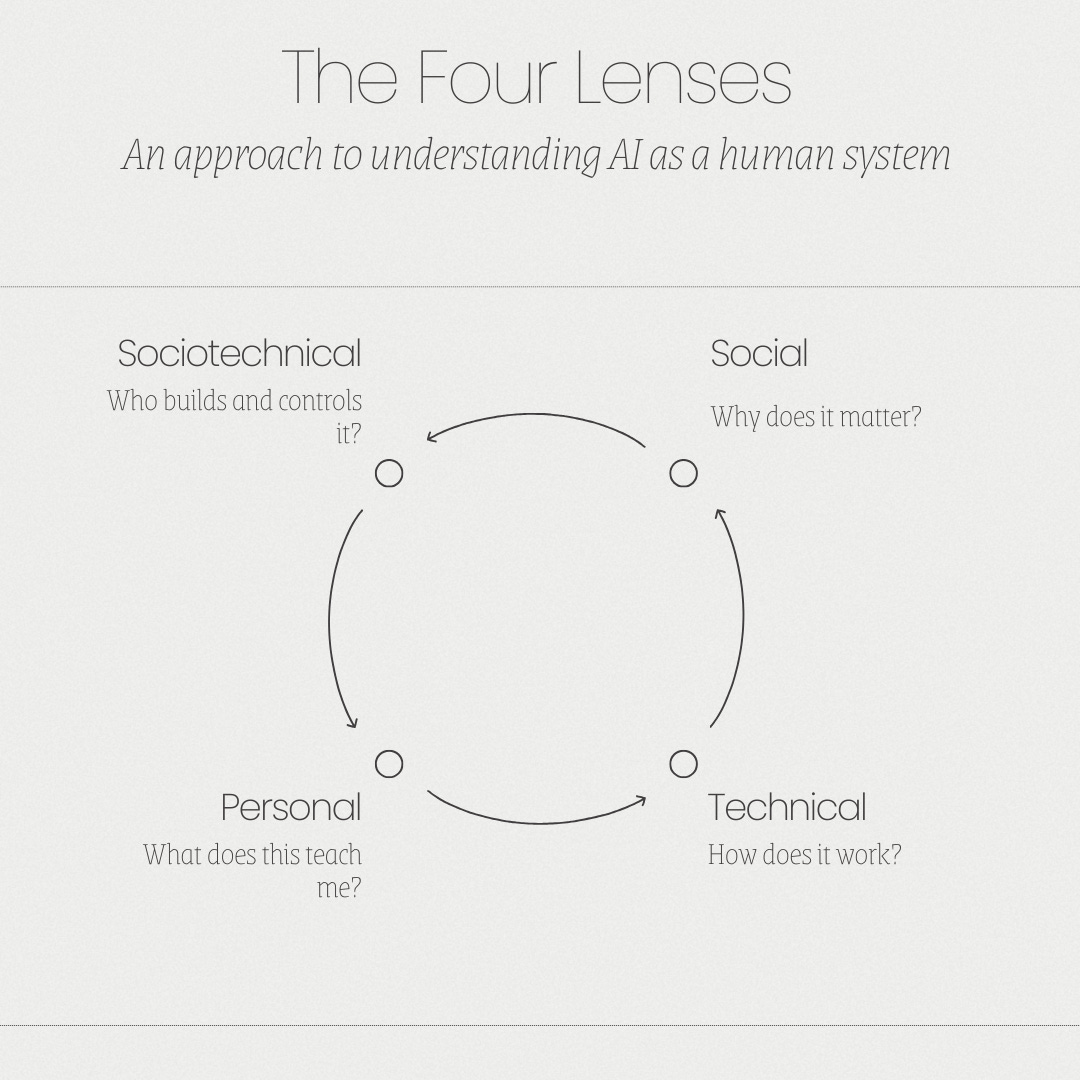
Learning began at the personal level. It gave me structure at a time when life felt uncertain. Curiosity brought focus and reminded me that understanding can create stability.
That curiosity naturally led to the technical lens. As I studied machine learning, I found clarity in data, models, and algorithms. The precision of these systems gave me a sense of control and progress.
From there, my background in economics and policy helped me see the social side of AI. I began to think about how technology reflects human choices and values. This lens helped me explore fairness, trust, and accountability from both technical and institutional points of view.
The sociotechnical lens brings these ideas together. It asks who builds and controls technology and how systems can be designed responsibly. It links the structure of algorithms to the power structures that surround them.
Eventually, my thinking returned to the personal. Learning about AI made me reflect on my own experience with it. I began to think about how my voice, identity, and background shape the way I see technology and the questions I ask. Each time I return to this point, I understand both the field and myself in a deeper way.
These four lenses now guide how I learn. They connect the personal, the technical, and the social into one continuous process. In a future post, I plan to share how I have organized my reading and notes around these lenses to keep my learning focused and connected.
Learning through technology taught me that explainability begins with how we make sense of ourselves.
When I look back, I see that this year was as much about learning machines as it was about learning myself. What began as a way to stay occupied became a way to rebuild how I understand, think, and focus.
Access to technology has changed what learning looks like. Courses, open materials, and large language models have made knowledge easier to reach. They have turned learning into something more personal, more adaptive, and sometimes more fragmented. In a time when attention is short and engineered, the ability to learn deeply has become its own form of privilege. The challenge now is to protect depth in a world built for speed.
For me, the Four Lenses have become a way to do that. They remind me to slow down, to connect ideas, and to learn with intention. That balance between depth and access, between reflection and technology, is where I want to keep learning from here.